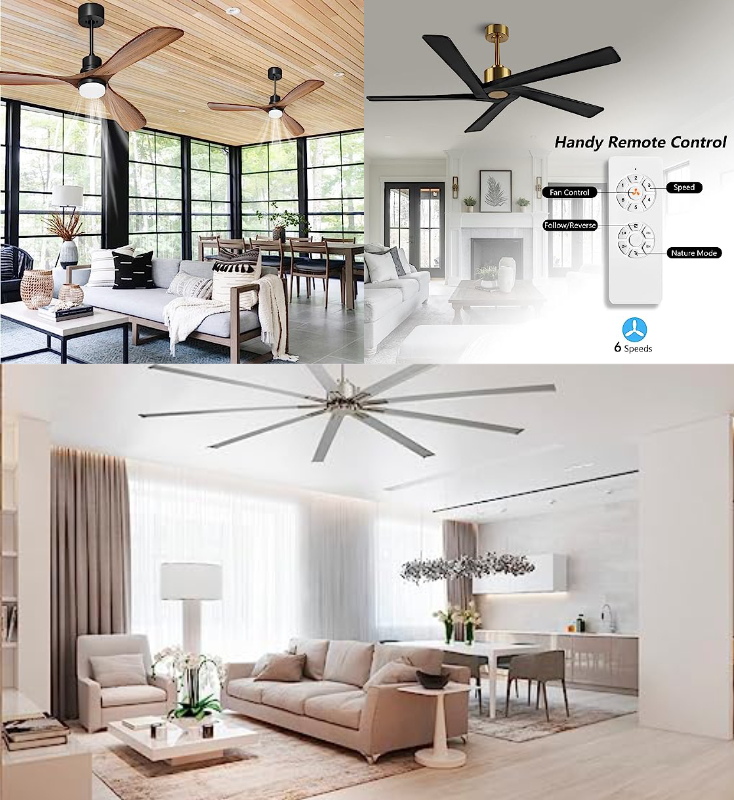
Ceiling fans are one of the most functional and energy-efficient ways to stay cool in the summer time and circulate heat through your home in winter by improving the air flow. A ceiling fan equipped with a light kit can also be a great way to add an additional source of lighting.
The size of your space and the amount of existing air flow will help determine the type of ceiling fan you’ll need. All of our fans feature high air flow at a low wattage for maximum efficiency, and run on different speeds, so you can control the output.
The CFM (cubic feet per minute) rate measures the volume of air moved by a fan. For larger spaces, you’ll want a fan that offers at least 3,000 CFM air flow.
Project Tip: If you plan on installing your ceiling fan outdoors, don’t forget to check the UL Rating. Just like with lighting, a wet or damp UL Rating will let you know how much exposure to moisture your fan can receive. Wet-rated ceiling fans can be exposed to the elements, while damp-rated ceiling fans must be installed in covered porches or outdoor lounge areas only.
What Size Fan Do You Need?
The next thing you’ll need to consider is blade span and ceiling height. Blade span is the diameter of the ceiling fan, measured from blade tip to blade tip.
For spaces like living rooms, bedrooms, or large bathrooms, opt for a fan with a 52- to 62-inch blade span. If you’re adding one to a vaulted space, you’ll want to consider a blade span of around 60 to 72 inches.
Project Tip: There should be at least seven feet of distance between the floor and the fan blades. If you have a vaulted ceiling or your ceiling is more than nine feet high, we recommend adding a longer downrod. After choosing the style of fan you want to order, you can configure the downrod length and rod finish as an add-on to your purchase. We offer multiple lengths to choose from—we recommend the following lengths based on ceiling height:
Downrod Length
- 12 inches – Ideal for 9-foot ceilings
- 18 inches – Ideal for 10-foot ceilings
- 24 inches – Ideal for 11-foot ceilings
- 36 inches – Ideal for 12-foot ceilings
- 48 inches – Ideal for 13-foot ceilings
- 60 inches – Ideal for 14-foot ceilings
- 72 inches – Ideal for 15-foot or higher ceilings
Vaulted Ceilings
Project Tip: If you have vaulted ceilings with a slope up to 52 degrees, use a hanger ball adapter like our convenient Ceiling Fan Adapter to make sure that your fan hangs straight.
Dual Direction Functionality
Some of ceiling fans feature dual direction functionality, a cost-effective approach that supports your home’s heating and cooling systems by dispersing warm or cool air more efficiently throughout the space.
Here’s the direction your fan should spin depending on the season:
Summer Fan Direction: Counterclockwise rotation creates a cool breeze by pushing air downward; the faster the speed, the cooler you will feel.
Winter Fan Direction: Clockwise rotation at a low speed creates an updraft, which pushes warm air trapped near the ceiling back down into the room; this circulates the warm air produced by your heating system throughout the space, keeping your house warmer with less energy consumption.
Your ceiling fan should also fit in with and add to the aesthetics of your space. Choose one that doesn’t feel too big or small and that works with the scale of your space and your existing furniture. Read on to explore our favorite ceiling fans from Amazon Prime Day 2023 that will help you stay cool in summer and keep warm in winter.
Outdoor Ceiling Fans
Click here for all of Amazon Prime Day 2023 Deals
